Static reading edition · s09-03
Tune reasoning with evidence
Choose a supported reasoning setting based on task difficulty and measured results.
Understand the approach
Reasoning effort gives the selected Codex model more or less computation for a task. Begin with the current client default; a harder investigation may benefit from a higher supported setting, but extra time or output length is not success. This differs from Claude’s thinking keywords, environment variables and /effort interface.
In the app use the model/reasoning control beneath the composer; builds with a Power selector expose exact choices through Advanced. In the CLI use /model to choose a model and supported effort; the IDE uses its model switcher below the composer. A one-run CLI override is model_reasoning_effort. Available labels and values depend on the model, account and build, so choose two values actually offered for the same model.
Use two fresh copies of the missing-both task and identical prompts, tools, permissions and rubric. Change only the supported effort. Retain actual outputs, diffs, elapsed time and available usage; grade both with the same extension checker and baseline suite. The supplied synthetic candidate comparison tests the rubric only. One observed pair is task-specific evidence, not a universal model ranking.
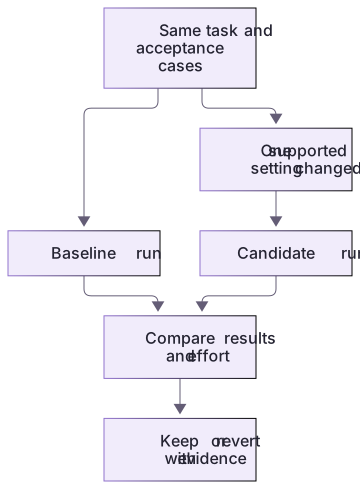
A fair reasoning comparison changes one variable

The baseline and candidate use the same task, fixtures, and success criteria. Compare observable correctness and effort, then retain or revert the supported setting. Do not infer correctness from longer output or a model label.
Keep the comparison proportionate
One successful trial can suggest a direction, but does not prove a universal advantage. If the task matters, repeat on representative cases and include failures rather than selecting only the best result. Avoid rerunning a large expensive workflow solely to fill a table. It is acceptable to conclude that a comparison is not worth its cost for a small edit, or that current evidence is insufficient to recommend a change.
About your environment
Verified October 21, 2026. Native controls depend on current client, account, model, host and managed policy. Local graders and isolated plugin metadata lifecycle were tested; authenticated model runs, app selection changes and scheduling were not performed by the course author.
Try it step by step
- Use the app model control or CLI /model; record the actual model, default effort and two supported comparison choices.
- Create two fresh generated packages, fix the extension prompt and acceptance checks, and keep tools/permissions equal.
- Run the same bounded implementation in two fresh chats with one effort difference. Save actual outputs and diffs separately.
- Run extension/check.cjs and the copied baseline suite for each. Record failures, elapsed time and available usage rather than selecting only a convincing answer.
- Restore the original app selection. If a run is unavailable, label the comparison unmeasured; never borrow the fixture result as a model score.
A useful starting example
Illustration · adapt before use.
/model

# One-run CLI override, keeping the configured model:
codex --config model_reasoning_effort='"medium"'
# Compare only if the same model supports this value too:
codex --config model_reasoning_effort='"high"'Catch a convincing omission
A synthetic result claims completion but reports no missing heading.
node labs/workflow-plugin/workflows/compare-candidates.cjssynthetic incomplete: FAIL - Claimed findings differ from the deterministic fixture evidence.
fixture reference: PASS - matches deterministic fixture evidence
No model comparison was run; use the same inputs and this rubric for a real supported-effort experiment.The failure demonstrates the evaluator can detect this known omission. It provides no performance ranking of real models or reasoning levels.
Your turn
Carry out the two-session comparison when you have a supported authenticated client and want to spend its normal usage. The deliverable is the two actual artifacts, identical grading, selected native settings and a modest task-specific conclusion. The offline rubric rehearsal can be completed independently, but it is not the effort experiment.
Try the exercise before opening its reference answer. Use a disposable practice folder.
Use a reproducible answer-quality rubric
Extract into a new practice folder and keep the included labs folder. Run these commands from that extraction root, or from the course folder, using an existing Node.js installation.
- Command 1 text
node labs/workflow-plugin/workflows/compare-candidates.cjsCheck: Labels the synthetic incomplete candidate FAIL, the fixture reference PASS, and explicitly states that no model comparison ran.
- Command 2 text
node labs/workflow-plugin/workflows/validate-artifact.cjs review labs/workflow-plugin/workflows/expected-review-result.jsonCheck: review artifact passed local checks. No client action was performed.
A fair reasoning experiment fixes the task and scores evidence-backed results. This local rehearsal tests the rubric, not any model or effort setting.
Check your result
- Exact current model/effort controls and both actually selected settings are recorded.
- Inputs and checks remain fixed; both final artifacts are graded, including failures.
- Synthetic evaluator checks, real inference evidence and unavailable observations remain distinct.
Reference answer & rubric Try the exercise before opening
First prove that your evaluation catches a plausible wrong answer; only then use it for a real supported-effort comparison.
- First prove the rubric catches the supplied incomplete synthetic candidate.
- Choose the same available model in two fresh sessions and record the actual effort labels; vary one supported effort only.
- Run the extension in two fresh packages with identical tools, permissions and task inputs.
- Save each actual diff/output, run the same grader and baseline suite, and record elapsed time/available usage.
- Report only the observed task-specific tradeoff. Missing inference runs mean unmeasured; do not request hidden chain-of-thought.
Check your understanding
What is the strongest evidence that a higher effort setting helped?
- It improves task acceptance on comparable inputs with an acceptable tradeoff.
- The answer contains more paragraphs.
- The model displays a more impressive setting label.
Reveal the answer and explanation
Answer 1: It improves task acceptance on comparable inputs with an acceptable tradeoff.
Assess the work produced and its cost in time or usage. UI labels and response length do not establish quality.
Take this quiz in the interactive lesson to save your answer in the browser.
When it does not work
Both candidates pass because they parse as JSON.
Likely cause: Only shape was validated, so a factual omission escaped.
What to try: Validate the complete result against the deterministic fixture evidence as well as the JSON schema.
A higher setting is declared better after only one run.
Likely cause: The baseline and changed input were not controlled.
What to try: Label the comparison unmeasured, fix the inputs, and run the same task in two supported settings if you choose to continue.
Common mistakes
- Requesting hidden chain-of-thought as though it were required evidence.
- Changing model, prompt, repository, and effort together, then attributing improvement to one control.
Source mapping & differences · different
Codex uses model-dependent reasoning controls rather than Claude's extended-thinking toggles or budget variables; compare outcomes on the actual surface.
Source topic: Extended thinking ↗Go to the source
Official documentation, checked 21 October 2026. Product names, controls and availability may vary with your version, platform or account.
Completion and quiz progress are saved
only in the interactive course.