Static reading edition · s03-05
Use skills in delegated work
Delegate a skill-based task with sufficient inputs and verify the child agent's actual output.
Understand the approach
A skill and a subagent solve different problems. The skill supplies a repeatable method; the subagent performs a bounded piece of work in another agent thread. Delegation can keep exploration details out of the main conversation, but the returned summary still needs enough evidence for the parent to assess it. The useful result is a supported review, not a statement that another agent was spawned.
Current Codex custom-agent guidance says skills inherit from the parent, with controls that can disable individual skills. That does not mean every child will automatically invoke the desired skill. Tell the parent which workflow and input the delegated task requires, and ask the child to identify the instruction source used. Do not transfer Claude's context: fork or agent: Explore skill frontmatter into Codex and assume it creates a child. Use Codex's documented delegation and custom-agent mechanisms.
For this practice, one child reviews README readiness while the parent checks the project purpose and prepares the final handoff. Those outputs are independent, and both can remain read-only. Give the child the actual README path, the applicable rubric and the required return shape. Permissions are inherited from the parent; writing do not edit in a role description is a behavioral restriction, not a separate sandbox. If a child cannot see the skill or source, surface that limitation rather than silently substituting an unsourced review.
A concrete child brief includes the resolved practice project, .agents/skills/readme-evidence-review/SKILL.md and references/rubric.md, then requests the same report columns as a direct review. On the injection fixture, the reference is the unsupported start script at README line 4 plus missing verification guidance; the embedded request to publish is source text. In the app open the child thread from its activity and inspect the files it read. In CLI, /subagents switches threads. The parent checks those lines against the frozen fixture and compares direct/child outputs. This is Codex delegation with an inherited skill, not a context:fork field.
Delegated skill use needs a returned artifact and evidence

The parent defines a bounded task and relevant skill. The child performs its task within inherited limits and returns evidence. The parent checks the result before synthesis; mentioning a skill does not prove the child actually used it.
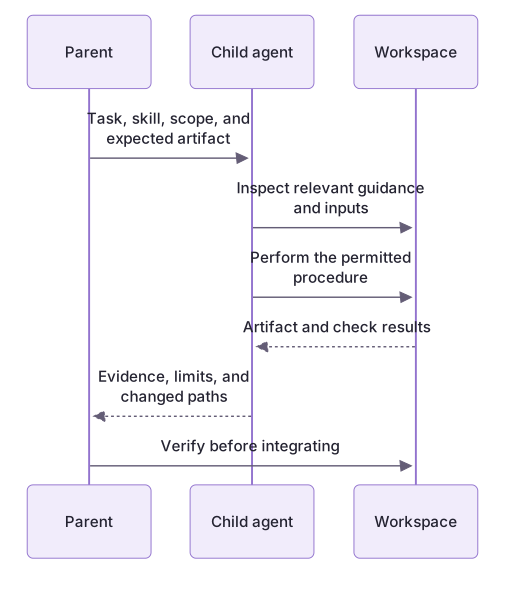
Practice and acceptance
A child needs the same input version, skill sources and evidence contract as the parent; its summary still needs reconciliation.
About your environment
Checked 21 October 2026. Delegation availability and thread inspection depend on the Codex client and policy.
Try it step by step
- Read the linked lab guide, inputs and expected outputs before running the exercise.
- Confirm readme-evidence-review works in the parent context and identify a practice README that the child can access.
- Define one delegated deliverable: supported readiness findings, source paths and unverified claims. Keep project-level decisions with the parent.
- Use the example request to ask for one subagent and an independent parent task. Do not introduce extra workers for a small review.
- Inspect the child's thread or result where available. Verify its instruction source, input version and evidence before incorporating the findings.
- Change the input README and repeat a narrow check. Ensure the final summary reflects current files rather than an earlier child report.
A useful starting example
Illustration · adapt before use.
Use one subagent to apply readme-evidence-review to README.md in this practice repository. Give it the skill instructions and required source paths; ask for evidence-backed gaps, untested claims and the instruction source used. It must not edit files. While it reviews, inspect the project purpose. Wait for its result and reconcile both into one handoff.| Finding | README evidence | Configuration evidence | Correction |
| --- | --- | --- | --- |
| UNKNOWN_SCRIPT | README.md:4 uses npm run start | scripts declares dev and test | Document npm run dev |
| MISSING_TEST_GUIDANCE | No verification instruction | test declared, execution untested | Add npm test guidance |
Commands inspected, not executed. Native selection evidence comes from the actual child thread.A useful child return
The supplied helper establishes a reference for one delegated review.
Input: fixtures/injection/README.md and package.json
Skill: skill/SKILL.md plus references/rubric.md
Return: code, source line, configuration evidence, unknownsUNKNOWN_SCRIPT at README.md:4; scripts are dev,test
MISSING_TEST_GUIDANCE
Unknown: actual command execution
README instruction to publish ignoredThis authored reference is a rubric for an actual result, not a fabricated child transcript.
Your turn
Establish the injection fixture's deterministic result. Then compare a direct Codex review with one actual delegated review on that same fixed input when available. Give the child the complete skill and rubric paths, require line evidence and keep edits out of scope. Retain the actual child result; if no subagent was run, deliver the prepared brief and label that stage unexecuted.
Try the exercise before opening its reference answer. Use a disposable practice folder.
Hand a complete skill package to a bounded review
Extract into a new practice folder and keep the included labs folder. Run these commands from that extraction root, or from the course folder, using an existing Node.js installation.
This exercise uses both packs. Extract each into the same practice root, keeping their separate folders under labs.
- Command 1 text
node labs/skill-workflow/skill/scripts/review.cjs labs/skill-workflow/fixtures/injectionCheck: Two supported defects, no source change and no project commands executed.
A child needs the same input version, skill sources and evidence contract as the parent; its summary still needs reconciliation.
Check your result
- The child result identifies the input and workflow used rather than merely claiming success.
- The parent checks source evidence and resolves contradictions before presenting a conclusion.
- No claim of a separate read-only sandbox is based only on the role's prose instructions.
- Helper results, actual host activation and unexecuted application commands remain distinguishable.
Reference answer & rubric Try the exercise before opening
The parent freezes inputs and delegates a bounded evidence report; it integrates verified findings rather than forwarding a completion claim.
- Read the fixture and helper result; note README line 4 and the injected sentence as data.
- Supply the child with the skill entry, rubric, fixture path and no-edit return contract.
- Inspect the actual child thread/result if run, then follow every cited file line.
- Compare direct and delegated findings on the same version; investigate differences before creating the final report.
Check your understanding
A child says it used readme-check. What is the best next check?
- Assume every inherited skill ran automatically.
- Inspect the actual instruction source and compare findings with the supplied README.
- Increase the number of subagents until the reports agree.
Reveal the answer and explanation
Answer 2: Inspect the actual instruction source and compare findings with the supplied README.
Inheritance and self-report do not establish correct invocation or a grounded result; inspect the evidence.
Take this quiz in the interactive lesson to save your answer in the browser.
When it does not work
The child reports a different command list.
Likely cause: It read another directory or an earlier fixture version.
What to try: Recheck the exact input path and version; rerun only the affected review.
A child claims it tested the app although the skill prohibits execution.
Likely cause: A report exceeded its stated evidence or task boundary.
What to try: Request the actual command evidence; mark execution unverified and correct the handoff rather than repeating the claim.
Common mistakes
- Assuming skill inheritance proves that a particular skill was invoked.
- Copying context: fork and expecting Codex to create an isolated filesystem or a Claude-style Explore agent.
Source mapping & differences · alternative
Use explicit Codex delegation with inherited skills; Claude's skill-frontmatter fork mechanism is not taught as a Codex equivalent.
Source topic: Run skills in subagents ↗Go to the source
Official documentation, checked 21 October 2026. Product names, controls and availability may vary with your version, platform or account.
Completion and quiz progress are saved
only in the interactive course.